
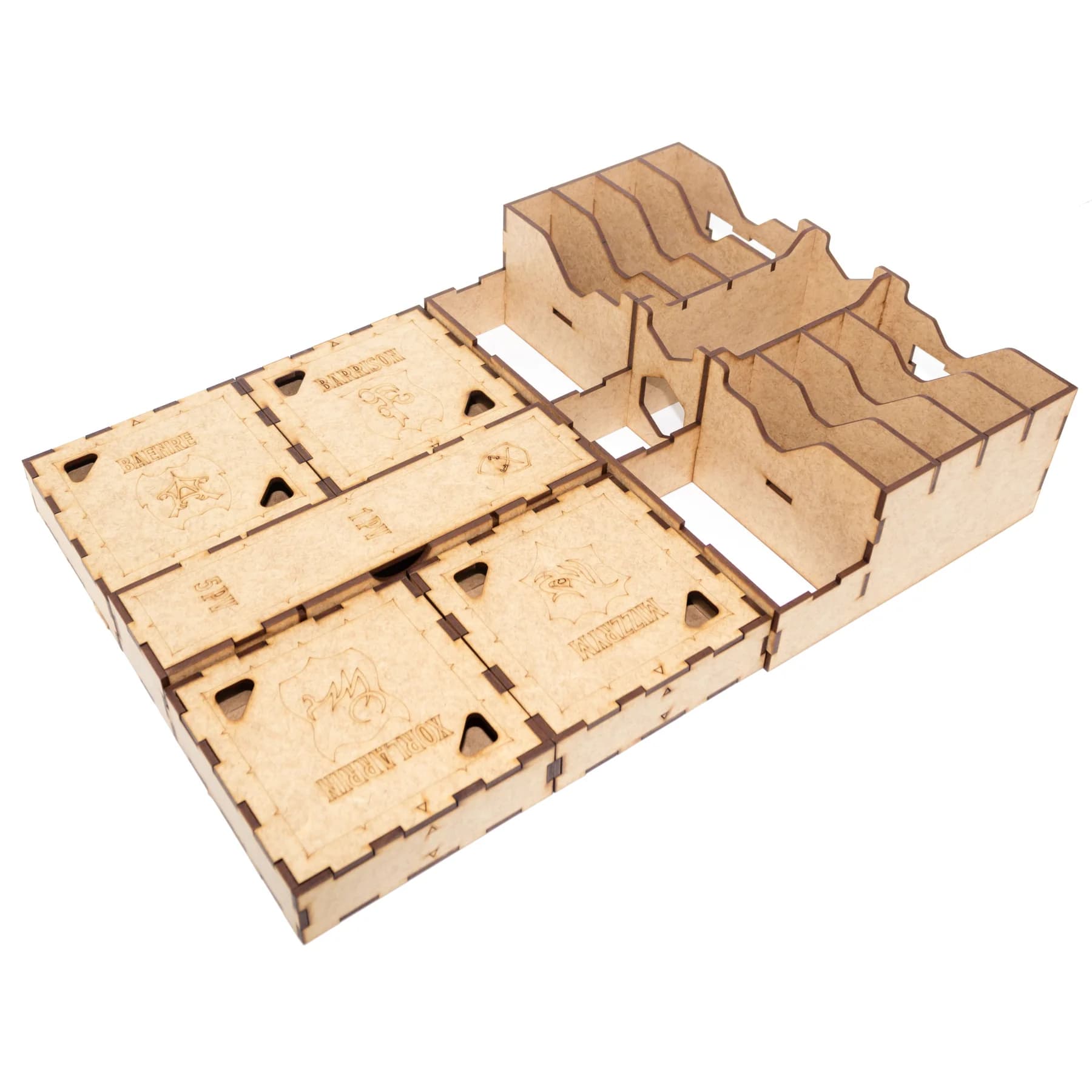
Ask a room full of gamers whether they sleeve their cards and you will start an argument that outlasts game night. An effective insert should adapt to the player — not the other way around.
Ask a room full of gamers whether they sleeve their cards and you'll start an argument that outlasts the game night.
One camp sleeves everything. That deck cost a Kickstarter pledge and a year of waiting, so why let table oil, chip crumbs, and a thousand shuffles wear it down? Sleeves protect the investment, and a fresh set of matte backs feels good in the hand.
The other camp plays bare. No sleeves means no bulk, no slipping, faster shuffling, and the box closes the way the designer intended. Cards are meant to be played, not entombed.
The reality is simple: both camps are right. And neither should have to fight their own organizer to play the way they like.
Why most inserts pick a side
Most inserts quietly commit to one side of the coin. They're cut to hold bare cards, tight and tidy. All good until you sleeve up and suddenly nothing fits, the lid won't close, and you're back to loose stacks and rubber bands. Or they're cut oversized for sleeves, and if you don't sleeve, the cards rattle around in a well built for someone else's deck.
Either way, the insert ends up telling you how to play your own game. That's backwards. An insert should adapt to the player — not the other way around.
What an insert should actually do
A card deck is often the most-handled, most-loved, and most-expensive-to-replace part of a game. That is particularly true whenever card play forms the core engine of the experience, such as in deckbuilders or living card games. Whether a player protects it with sleeves or protects it by keeping it clean and bare, it is the same instinct: taking care of something worth caring about. An effective storage solution respects that drive rather than overlooking it or, even worse, dictating how you handle your components.
So sleeved-or-unsleeved should not be an afterthought in a design. It must be part of the spec from the start. In execution, this demands card compartments engineered around standard real-world sleeve tolerances, along with removable dividers ensuring raw cards remain secure without shifting. Modular partitions offer added versatility for custom configurations, all while guaranteeing the game box lid rests entirely flush regardless of your choice. The goal is simple: cards sit secure, the box shuts, and setup is grab-and-deal no matter which camp you are in.
It comes down to respect for how people play
An effective storage solution should never suggest you are enjoying your hobby incorrectly. Protect every single deck, skip the protection entirely, or layer on double sleeves — whatever your preference, your insert must simply work. That is the standard every solution should be held to: it earns a place at the table on the player's terms.
Because the point was never the insert. The point is the game, and the years it will be played. Everything else should be built to be worthy of that. That is the standard we always strive to achieve in our creations.